

Suffice to say that artificial intelligence (AI) has become a permanent part of the drug-discovery conversation. Its applications are diverse and include patient stratification, biomarker discovery, clinical trial optimization, and treatment-response prediction. AI is increasingly being used to generate insights datasets that are diverse or are too large and complex for traditional analytical approaches .
What may have been less clear till more recently is how these AI-derived findings should be validated before they begin influencing decisions in drug development or clinical care. We likely agree that we’ve reached a point of AI and genAI adoption where this question is no longer theoretical and needs to be addressed. In response, regulators, clinicians, and researchers have started developing formal frameworks that evaluate AI-generated evidence. The FDA’s guidance on AI in drug development and the 10 guiding principles established between CDER, CBER, and EMA are amongst some of the frameworks documented.
Addressing Similar Risks
In this AI-forward era, regulatory guides and guardrails have helped organizations balance eager appetite with sound science within drug discovery & development (DDD). The focus is on verifying and establishing credibility towards AI-generated evidence (and by default its AI technology platform), which roots itself in a specific, defined question of interest and context of use; in other words, the answer to the question, “What is the specific regulatory use case/intended use for which a decision is being made?”
Whether identifying a potential target or pathway, drug modality or delivery methods, stratifying patients for a clinical trial to predict treatment response, or supporting a regulatory submission, the intended use of the model becomes the starting point for determining the level of evidence required. The discussion is already moving beyond performance metrics, including accuracy, sensitivity, specificity, and prediction; a highly accurate model may still be deemed insufficient and inappropriate if its logic is black-boxed, its output is too complex, or its recommendations are not adequately validated within its biological context or its intended use. As an industry, we are no longer focused on whether AI models work generally, but rather whether the evidence produced is credible enough to support one very particular decision.
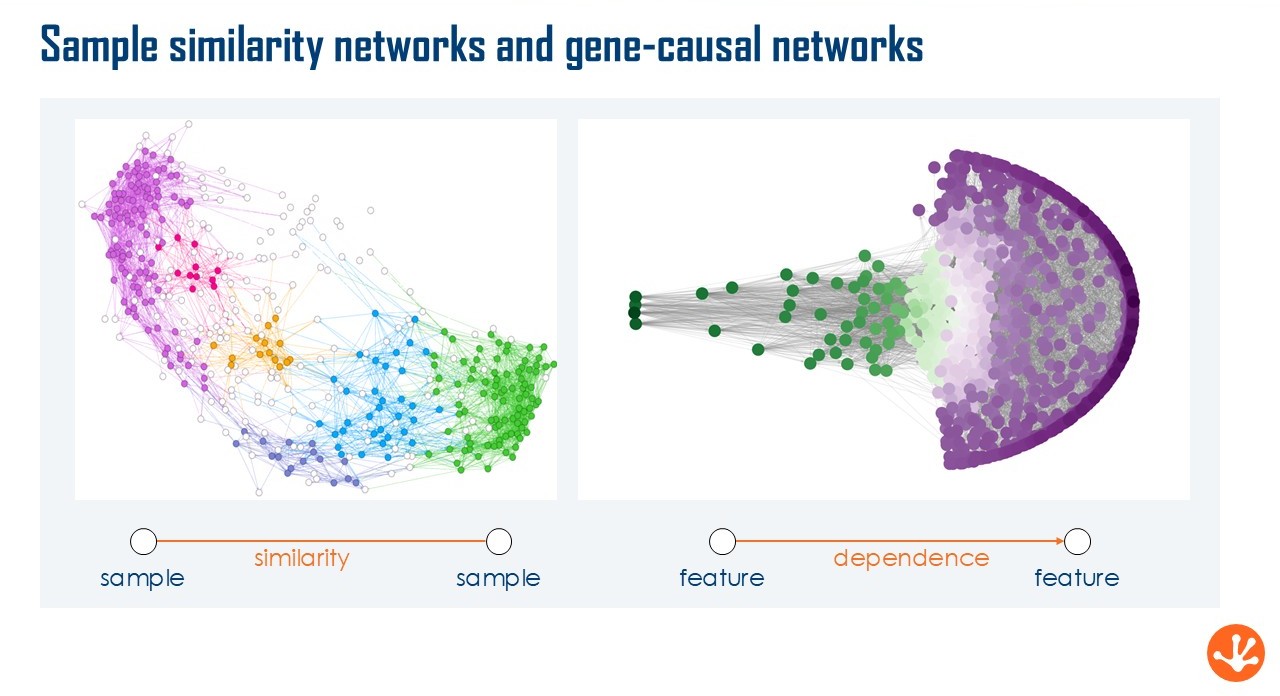
Figure 1: Example of AI utility in establishing sample similarity networks and/or gene-causal networks for complex disorders.
Start With the Question, Not the Technology
The emphasis is on the importance of defining both the Question of Interest and the Context of Use. Drug program sponsors in biotech and pharma alike are encouraged to first clearly identify the biological, clinical, or regulatory question that needs to be answered before having conversations on how an AI model should be assessed as a viable tool. Just like techniques and assays are considered when answering a fundamental biological question, this rigor extends into the AI technology stacks.
For drug discovery teams, this distinction is increasingly important. The evidence required for an exploratory target-discovery model is very different from those required for a model used to identify, say, responder populations in an early-stage clinical trial. The underlying algorithms may have similarities, but the decisions they support are not. By grounding validation around intended use rather than technology alone, the proposed framework recognizes that context is just as important as methodology.

Figure 2: Systematized approach to small queries and built-in iterations of structured prompts for agentic AI architecture within drug discovery and development.
Recognizing AI Applications Carry Different Levels of Risk
A risk-based framework for therapeutic utility inherently includes proportionality, where validation expectations increase according to the influence an AI model will have on a clinical outcome and, importantly, on the severity of the consequences of that decision being wrong. Lower-risk exploratory analyses will have higher tolerance than applications or product approvals that could directly affect patient safety or future quality of life.
This approach recognizes an important reality about modern AI adoption: in the noise and hype of a we-can-do-everything-with-AI approach, there is recognition that not every model deserves the same level of scrutiny. For AI and genAI DIYs or external technology adopters alike, this means that there will be increased attention given to validation, documentation, and supporting evidence for human oversight and auditability.
Building Credibility as a Structured Process
Credibility is used frequently when speaking about a source or person with immense knowledge – a word charged with humanity. The challenge is to build an unbiased assessment of an AI platform’s credibility as a structured process. This process requires definitions of what it means to be a credible model, what validation needs to be performed and be maintained, what constitutes documentations of its performance, and ultimately a recognition/certification that the model is now suitable for its intended use.
Scientific decision-making has always involved incomplete information, competing hypotheses, and varying levels of confidence. Despite its benefits, AI can’t alter this core principle. Just as people become experts in their field, AI models are expected to add value by collating data-backed evidence, surfacing insights, and helping to rank decisions better than current qualitative scales of ‘good’ or ‘bad’ based on subjective weights. The framework, then, recognizes the uncertainty inherent to the field of human health and puts AI-generated evidence within that context rather than seeking to eliminate it altogether. It also emphasizes evidence generation, structured processes, and transparency on the algorithms used to train AI on a specific role.
Fit-for-Purpose Validation, but Generalized Enough to Adapt to the Real World
Anyone can recognize that there’s a real difference between the classroom or a controlled environment vs the real world. It’s no surprise then that a model that performs exceptionally well with a static, relatively homogenous dataset may behave quite differently when applied across massive and highly heterogenous datasets; biomedical datasets are complex, incorporating clinical outcomes from diverse patient populations, multi-omics profiles from different molecular and imaging technologies, longitudinal real-world evidence, and other heterogeneous data sources that vary significantly across institutions.
Therefore, the validation tied to intended use must be confirmed in the backdrop reflective of real-world deployment. For any organization playing in the sandbox of drug discovery and development, this requires considerable emphasis on demonstrating that their AI systems remain reliable across relevant environments and populations. In practice, this means that AI credibility must extend into real-world applicability from the get-go, within their validation roadmap. If left as an afterthought, organizations risk a stall or in the worst case, program abandonment due to their inability to demonstrate consistency and clinical durability.
Transparency Remains Foundational
Transparency, coupled with an agencies’ jurisdiction for review, is another theme we highlight here: practical checkpoints requiring documentation of data provenance and protection, assumptions made and accepted, details of validation methods employed, known limitations within the technology, monitoring strategies to manage AI-driven tendencies, and scheduling of routine performance assessment are but some of the essential components we anticipate as upcoming requirements, if not already, to build trustworthiness from an AI platform.
This perspective, again, aligns closely with how biomedical science has traditionally progressed: research and translational findings become useful only when they can be reviewed, challenged, replicated, and independently verified. AI-generated evidence should be, at minimum, treated with the same level of scientific scrutiny, and for that to happen, each recommendation must be explainable to the scientific and clinical community at large.
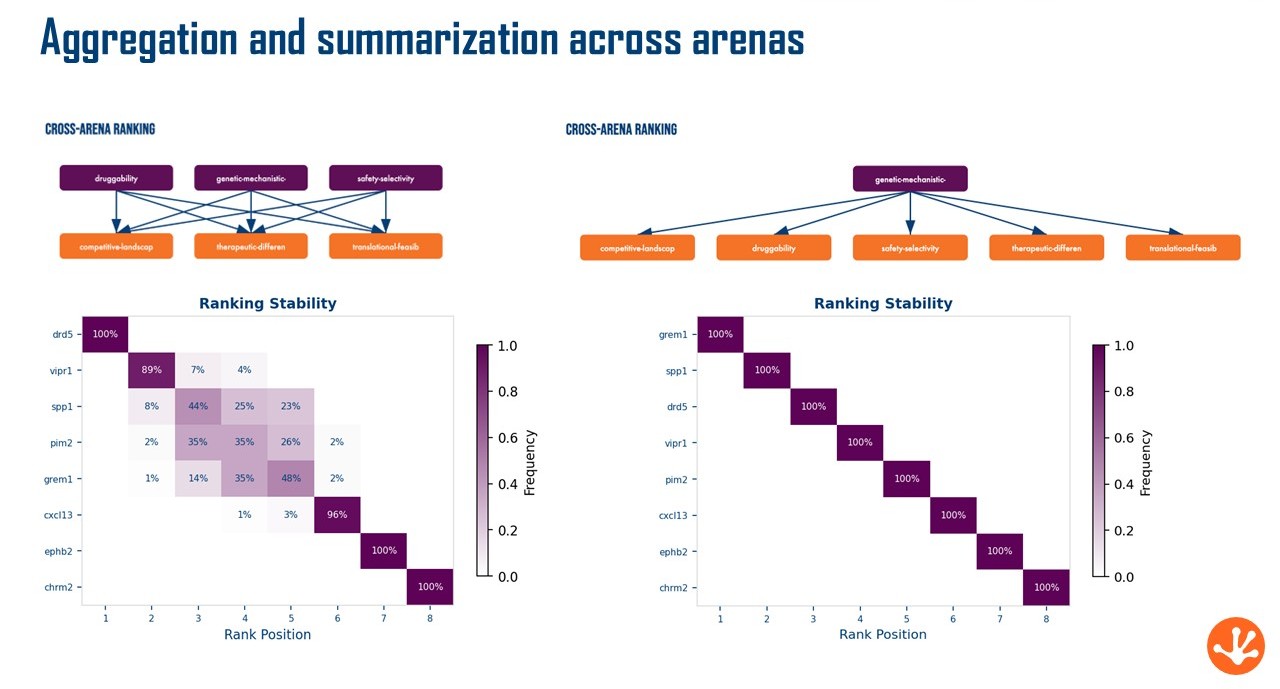
Figure 3: Adoption of quantitative rankings over qualitative scoring systems as structured comparisons in individual arenas for target and tractability prioritization decisions.
Looking Ahead
All said, optimism continues. There is recognition that the availability of specialized solutions that prove themselves beyond the standard specs of larger models, bigger architecture, or faster computation is an undeniable force accelerating drug discovery. The recommendations offer guardrails but need not constrain innovation, instead providing practical approaches to validation and explainability within the AI technology’s ability to answer specific questions that can be trusted, challenged, audited, and ultimately provide real value in making meaningful decisions for patients.