

Artificial intelligence (AI) has already demonstrated an ability to uncover patterns across datasets and biological systems that are difficult, slow, or in some cases impractical to evaluate using traditional analytical methods alone. Across drug discovery and development (DDD), applications now span target identification and validation, molecular design, biomarker discovery, patient stratification, clinical trial design, and prediction of treatment response. Several reviews of AI use in target discovery, validation optimization, and data analytics have documented the increasing ability of machine learning approaches to integrate diverse biological modalities and identify potentially actionable relationships across large-scale data1.
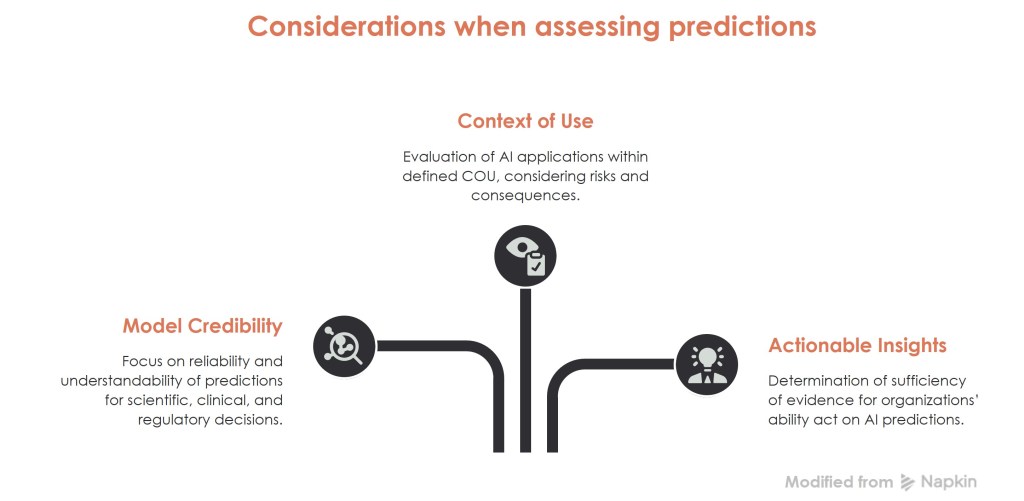
Representation of some of the core considerations when adopting AI models in drug discovery decisions.
Context of use as part of the validation challenge
The growing importance of these questions is increasingly reflected in regulatory activity itself. For example, the FDA reported experience with more than 500 drug-development submissions containing AI components between 2016 and 2023, spanning nonclinical, clinical, manufacturing, and post-marketing activities. Most regulatory bodies likely note that AI-generated evidence is no longer a future consideration for their reviewers and regulators; it is already appearing across multiple stages of the DDD lifecycle2.
The path to maturity for AI applications that have successfully advanced from nascency, however, depends on relevant measure of progress that now extends beyond whether an AI model can generate a compelling prediction; it is rather, based on whether the evidence supporting that prediction is sufficiently credible and understandable for those making scientific, clinical, or regulatory decisions for which AI and machine-learning tools are intended to inform.
It’s useful to recall draft guidance published over a year ago that emphasized model credibility within a defined Context of Use (COU), with risk assessed relative to both the model’s influence on a decision and the consequences associated with an incorrect outcome3,4. Indeed, after years focused largely on what AI can do, attention is increasingly turning toward the conditions under which organizations should be prepared to act on what AI systems are predicting and informing.
Prediction and inference in drug discovery
Research, also within drug discovery, has always required decisions to be made using varying amounts and qualities of evidence. Scientists routinely weigh biological plausibility, experimental reproducibility, prior literature, competing hypotheses, and translational relevance when determining whether an initial finding warrants further investment. Just because the evidence originates from a computational model using AI should not change that scientific process and due diligence.
This is where conventional performance measures such as accuracy, sensitivity, specificity, precision, recall, and predictive performance need to sit within a broader scientific framework; the same framework that has led to some astounding scientific breakthroughs historically. A model can perform sufficiently according to predefined computational benchmarks while still leaving important questions about whether its outputs are meaningful:
- Are outputs biologically relevant?
- Are experimental plans feasible and reproducible?
- Does it operate under a premise that is sufficiently robust for its intended context?
What it should not experience is unintended scope creep without built-in checkpoints that recognizes its own (in)adequacy to influence a decision of greater translational, clinical, or regulatory consequence without gathering more evidence3 – 5.
Consider the difference between a model used to prioritize exploratory targets for laboratory investigation and a model whose outputs contribute to identifying patient populations for a clinical development program. Both may generate scientifically useful predictions, but the consequences of an incorrect prediction are quite different. The practical implication is that organizations may lean towards AI-generated evidence integrating itself as a factor for consideration rather than within a binary space of ‘validated’ and ‘not-validated’ evidence.
This distinction is particularly important as clinical attrition remains high and analyses of drug development programs continue to show substantial rates of failure across clinical development6,7. The importance of better understanding the evidence, the inference generation from an AI models’ prediction, and resulting assessment of whether the supporting evidence is robust enough is reinforced. This seems to align with the current perspective of practiced risk-based validation frameworks and tiered approaches in which evidentiary expectations increase, as it should, with severity of translational significance8.

Representation of the relationship of uncertainty, validation, risk assessment for evidence and AI-inference.
Defining acceptable uncertainty into validation frameworks
Accepting uncertainty is already challenging in biomedical research. Introducing concepts such as ‘good enough’ into AI and machine-learning workflows can therefore be understandably uncomfortable. It comes down then, to defining more precisely what contributing role the AI model would play as within fit-for-purpose validation frameworks that requires ultimately, a level of accepted uncertainty. A model contributing directly to clinical development decisions, evidence generation, or regulatory submissions naturally invites more rigorous examination of its assumptions, training data, limitations, reproducibility, and performance characteristics.
For rigorous examination, transparency and auditability is something we should expect to receive – and share. Viewed in this light, the challenge is not establishing certainty. Rather, it is determining whether identified uncertainty has been sufficiently characterized and deciding whether the remaining uncertainty currently not addressed is acceptable or is the better choice given the consequence of the decision being made. This concept is increasingly reflected in both regulatory guidance and proposed validation frameworks, which emphasize proportionality between evidentiary expectations and decision risk rather than reliance on any one universal validation and go/no-go threshold3,8.
When the volume of AI predictions outpaces validation
Our industry understands that modern AI platforms can generate predictions at an astronomical rate that at least for now, far exceeds the pace at which those predictions can be experimentally evaluated. Foundation models, multimodal machine learning systems, and large-scale biological AI platforms are accelerating the hypothesis generation across genomics, transcriptomics, imaging, and clinical data, while wet lab and clinical validation continues to operate at a pace that automation may help with, but realistically, only to a specific extent.

From Niazi, S. K. A Risk-Tiered Validation Framework for Artificial Intelligence in Drug Discovery: From Reproducibility to Clinical Translation. (2026). Taken directly, without modification, from Figure 3. Ensemble-aware AI-driven workflow for drug discovery.
The scale of modern AI-driven evidence generation makes this gap increasingly visible. The AlphaFold Protein Structure Database alone now provides open access to more than 260 million predicted protein structures, illustrating how rapidly computational systems can generate biologically-relevant outputs relative to the pace at which those outputs can be experimentally evaluated and move forward for lab and clinical validation. We are at a place where recent risk-tiered validation frameworks acknowledge that perhaps the primary bottleneck in AI-enabled drug discovery may increasingly be on validation rather than on the accuracy of the prediction itself. The challenge is therefore no longer only improving AI model performance, but re-visiting classic validation frameworks so to make them more capable of keeping pace with the increasingly scalability and automatability of these inference and evidence-crawling workflows8,9.
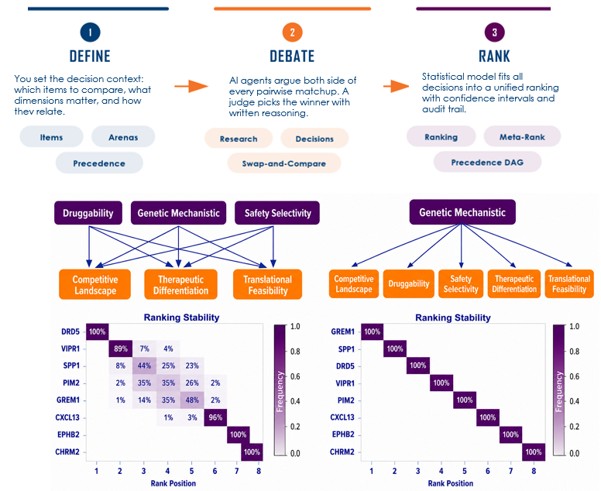
Representation of an LLM-enabled target prioritization & decision support framework with bfARENAS™.
Decision readiness as an evidence standard
Perhaps the natural progression is heading from AI capability to AI credibility, and what it takes to translate credibility into decision readiness when AI-inference is a key driver of evidence.
Credibility establishes whether there is sufficient reason to trust a model’s performance within a particular context. Decision readiness extends that discussion by asking whether the resulting evidence, together with its remaining uncertainty, is appropriate for the purpose (and resulting consequence) of the decision being made. This evolution is reflected in many practices in the field, in regulatory guidance that emphasize context, risk-based assessment, multidisciplinary expertise, and lifecycle management as new evidence and information arises, and in more AI use case and evaluation frameworks, where transparency, validation, and characterization of uncertainty are increasingly and explicitly treated as part of the evidence itself.
Reference
- Wenteler, A., Cabrera, C. P., Wei, W., Neduva, V., & Barnes, M. R. (2024). AI approaches for the discovery and validation of drug targets. Cambridge prisms. Precision medicine, 2, e7. https://doi.org/10.1017/pcm.2024.4
- https://www.fda.gov/about-fda/center-drug-evaluation-and-research-cder/artificial-intelligence-drug-development, accessed Oct 9, 2026.
- https://www.fda.gov/regulatory-information/search-fda-guidance-documents/considerations-use-artificial-intelligence-support-regulatory-decision-making-drug-and-biological, accessed Oct 9, 2026
- https://www.fda.gov/news-events/press-announcements/fda-proposes-framework-advance-credibility-ai-models-used-drug-and-biological-product-submissions, accessed Oct 9, 2026
- https://www.ema.europa.eu/en/news/ema-fda-set-common-principles-ai-medicine-development-0, accessed Oct 9, 2026
- Sun, D., Gao, W., Hu, H., & Zhou, S. (2022). Why 90% of clinical drug development fails and how to improve it?. Acta pharmaceutica Sinica. B, 12(7), 3049–3062. https://doi.org/10.1016/j.apsb.2022.02.002
- Wong, C. H., Siah, K. W., & Lo, A. W. (2019). Estimation of clinical trial success rates and related parameters. Biostatistics (Oxford, England), 20(2), 273–286. https://doi.org/10.1093/biostatistics/kxx069
- Niazi, S. K. (2026). A Risk-Tiered Validation Framework for Artificial Intelligence in Drug Discovery: From Reproducibility to Clinical Translation. International Journal of Molecular Sciences, 27(10), 4349. https://doi.org/10.3390/ijms27104349
- https://alphafold.com/, accessed Oct 12, 2026